Wide Load: What Oversize Boat Transport Involves
Once your boat is wider than about eight and a half feet, the haul stops being ordinary freight. Here is what permits, escorts and travel restrictions actually mean for your delivery date.
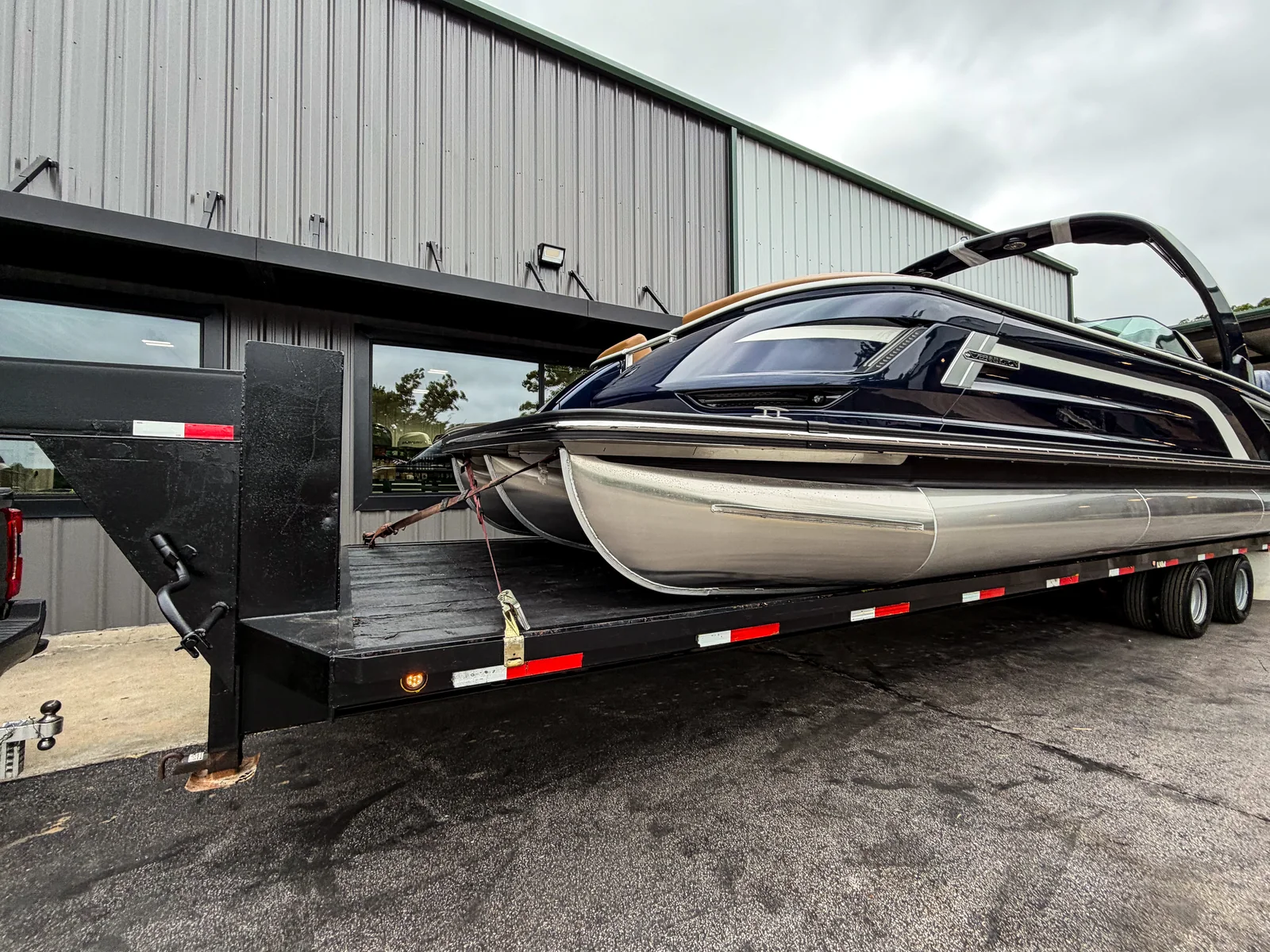
There is a line in trucking at roughly eight feet six inches of width. Under it, a load is ordinary freight and it goes wherever the truck goes. Over it, the load is oversize, and a whole apparatus of permits, markings, escorts and travel windows switches on.
A great many boats sit on the wrong side of that line. Most pontoons do. Plenty of cruisers, deck boats and anything with a beamy hull do. It is not a problem and it is not unusual, but it changes the planning, the cost and above all the schedule, and it is the part of a boat haul that surprises people most.
Here is what actually happens, so that when a hauler tells you the delivery is a four day window rather than a Tuesday, you know why.
Measure the widest point of your hull, including rub rails, before you do anything else. That one number decides whether everything on this page applies to your boat or none of it does.
Where ordinary freight ends
The standard legal width on the interstate system is eight feet six inches. That is the number a trailer, its load, and anything hanging off it has to stay inside to travel without special permission.
A boat is measured at its widest point, and the widest point is almost never where the owner thinks. Rub rails count. Hull flare counts. Anything bolted to the sides counts. A boat listed with an eight foot six beam frequently measures wider than that in reality, which is the single most common reason a quote has to be revised.
Height has its own version of the same line, generally around thirteen feet six inches to fourteen feet depending on the route, measured from the ground with the boat on its trailer. Length matters too, though boats hit the width limit long before they hit the length one.
Get an actual tape on it. Two people, one at each rub rail, measuring straight across at the widest point rather than diagonally. Then measure the height on level ground. Those two numbers determine everything downstream.
One state, one permit, every time
Oversize permits are issued by states, not by the federal government, and there is no such thing as one permit that covers a whole trip. A run from Missouri to Florida crosses several states and needs a permit from each, every one with its own application, fee, rules and processing time.
A permit is not just permission to be wide. It typically specifies the route the load must follow, the dates it is valid for, the hours travel is allowed, and what markings and escorts are required. Deviating from a permitted route is not a technicality, it is the difference between a legal load and a very expensive stop.
Processing time is why lead time matters. Some states issue permits the same day through an online system. Others take days. A few require a route survey for unusual dimensions, which takes longer still. This is the main reason an oversize haul cannot be booked for tomorrow the way a car can.
Permits are also priced per state and they are a genuine line item, which is why a quote that never asked about your beam has almost certainly not accounted for them. The cost breakdown covers how this lands on a price.
Banners, lights, escorts and what width triggers what
Requirements step up with width, and the exact thresholds vary by state, which is part of why a multi state run takes planning.
- Just over the limit. Usually oversize load banners front and rear, red or orange flags at the widest points, and amber warning lights on the truck.
- Wider than that. A pilot car, also called an escort vehicle, running ahead of the load to warn oncoming traffic and watch for obstructions. Some states require one in front and one behind.
- Wider still, or tall. A height pole car, which runs ahead with a flexible pole set to the load height to catch low wires and structures before the boat does.
- Unusual dimensions. Police escorts on certain routes, or a full route survey before the permit is issued.
Pilot cars are a real cost. They are separate vehicles with certified operators, and they are paid by the mile for the portion of the route where they are required. On a long haul that adds up, and it is another thing a suspiciously cheap quote may have quietly left out.
Why your delivery is a window, not an appointment
This is the part that catches people, and it is worth understanding before you book a flight or tell a marina to expect you.
Daylight only. Most states restrict oversize movement to between sunrise and sunset. A load that could legally run through the night as ordinary freight simply stops when the light goes, which turns a long day into two.
Curfews. Many states prohibit oversize travel through metropolitan areas during rush hours. A route through a major city may mean sitting for several hours waiting for a window to open.
Weekends and holidays. A significant number of states do not allow oversize movement after a certain hour on Friday, at all on Sunday, or around major holidays. Hit a holiday weekend and a load can be parked for three days.
Weather. Permits routinely include wind restrictions, and high wind on a tall wide load is genuinely dangerous rather than merely inconvenient. Snow, ice or heavy rain stops an oversize load where it would only slow an ordinary one.
Add the delays together and the picture is clear. An oversize haul that would be two days as standard freight can honestly take four or five. Anyone promising you a fixed arrival hour on a wide load is either not planning to keep it or not planning to be legal.
Not sure if your boat is oversize?
Send the beam at the widest point and the height on the trailer. We will tell you which states need permits and what the realistic window looks like.
Getting under the line where you can
Width is fixed. The hull is the hull, and nothing short of a saw changes it. But height is often very reducible, and dropping under a height threshold can simplify a route enormously.
Things that commonly come down: radar arches that fold or unbolt, wakeboard towers, biminis and enclosure frames, antennas, outriggers, and anything on the hardtop. Some of it is ten minutes with a wrench and some of it needs a rigger, but the payoff is real when it moves a load from a permitted route onto the interstate.
Trailer choice matters too. A lower deck height means a lower overall load, which is part of why boats ride on a lowboy rather than a flat deck. Where the boat sits on the trailer and how it is blocked affects the final number as well.
Tell whoever is quoting exactly what comes off and what does not. It is a short conversation and it occasionally saves more than any other decision in the job. Pontoons in particular have their own considerations, covered on the pontoon and tritoon transport page.
What to ask, and how far ahead
Lead time is the whole game. Permits take days, pilot cars have to be scheduled, and the routes that work for wide loads are finite. Two to three weeks is comfortable for a multi state oversize haul. A week is tight. Tomorrow is not happening, and anybody who says otherwise is worth a second question.
Ask any hauler these, and compare the answers rather than the figures:
- Are permits included in this price, and for which states?
- Are pilot cars included if my width requires them?
- Have you run an oversize load on this route before?
- What is the realistic delivery window, allowing for daylight only travel and curfews?
- What is your cargo insurance limit, and can I see the certificate?
- Are you the carrier, or are you posting this to a load board?
That last one matters more on oversize work than on anything else. Permits are pulled by the carrier running the load, against that carrier’s authority and that specific truck. A broker cannot do that work until a carrier has accepted the job, which is why an oversize load posted to a board and left uncovered simply sits. There is more on that in the carrier versus broker post.
We pull our own permits and run our own truck, which is why we can tell you honestly what the window looks like. Send the beam, the height and both ends and we will tell you what your haul actually involves.