
What Boat Transport Actually Costs
Not a rate chart. The seven things that decide what your haul is worth, why beam matters more than length, and how to read a quote that looks too good.
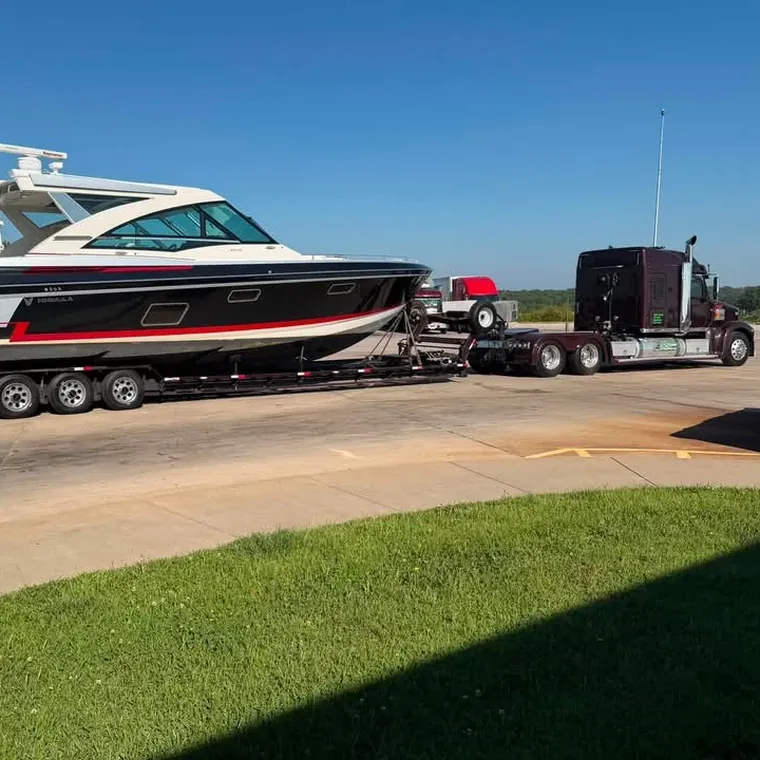
There is no price list for boat transport, and anybody who publishes one is either quoting a narrow slice of easy work or planning to revise the number later. A boat is not a standard box. Two boats of the same length can be entirely different jobs depending on how wide they are, how tall they sit, and whether the thing has a trailer under it.
So this page has no figures on it. What it has instead is every lever that moves the price, ranked roughly by how much it matters, so that when quotes come back you can tell which ones were built on your actual boat and which ones were built on a guess.
We haul boats for a living on a lowboy out of Eldon, Missouri, so the framing here is the same one we use when we price a run for ourselves.
If you take one thing from this page: beam is the number that matters most, and it is the number sellers most often get wrong. Measure the widest point of the hull including the rub rails before you ask anybody for a price.
Width decides more than anything else
Length is what a boat is sold by and beam is what it is hauled by. Once a load is wider than the standard legal limit, roughly eight and a half feet, it stops being ordinary freight and becomes an oversize load, and the entire cost structure changes with it.
An oversize load needs a permit from every single state it crosses, each with its own fee, its own application, and its own rules. Wider still and the requirements stack up: banner and flags, amber lights, restricted hours, no travel on certain holidays or weekends, and above a certain width, pilot cars running ahead of the load. Some states will not let an oversize load move at night at all, which turns a run that could be done in two days into one that takes four.
None of that is exotic and none of it is a problem. It is planned in advance and it is a normal part of hauling boats. But it is real money and real time, and it is why a twenty eight foot boat with a wide beam can price above a thirty four foot boat that squeaks under the limit.
Measure it yourself, do not trust the listing. Manufacturers quote beam at the hull, sellers repeat the brochure, and neither number includes the rub rails, the flare or anything bolted to the sides. We quote against the number you give us, so a quote built on a wrong beam is a quote that has to change.
Height decides the route, and the route costs money
Height is measured from the ground to the highest fixed point with the boat sitting on its trailer, and it is the second big one. The practical ceiling on most routes is a little under fourteen feet, and every bridge, overpass, power line and low branch between the two ends has to clear it.
When a load is too tall for the direct route, the answer is a different route. That can mean a longer way around, secondary roads instead of the interstate, or a permit with a specified path the load is required to follow. All of those add miles and hours.
The useful part is that height is often the most reducible number on the boat. A radar arch that folds, a tower that unbolts, a bimini that comes down, antennas and outriggers that unscrew. Taking a foot off the top can move a load from a permitted route to an ordinary one. Tell us what comes off and what does not, because that conversation sometimes saves more than any other single thing on this page.
Whether it has a trailer, and whether that trailer is road worthy
There are three versions of this and they price differently.
- Boat on its own road worthy trailer. The simplest case. The boat is already blocked and supported correctly by a trailer built for that hull, and it is hauled as a unit.
- Boat on a trailer that has been sitting. Common on a purchase, and the trailer is the risk rather than the boat. Tires with cracked sidewalls, bearings that have not been greased in years, lights that do not work, a coupler that is seized. Any of it can strand a load.
- Boat with no trailer at all. Then the hull rides directly on the lowboy and it has to be blocked and cradled properly for its shape, which is careful work. It also means a lift or a crane at both ends, and somebody has to arrange and pay for that.
If a trailer is coming along, look at the date codes on the tires. Rubber ages whether or not it rolls, and a six year old tire that looks fine is not fine at highway speed under load. Replacing two tires before the trip is cheaper than what happens when one lets go on the interstate.
Weight, and everything people forget is in the boat
Dry weight is a marketing number. What actually rides on the trailer is dry weight plus fuel, plus water in the tanks, plus batteries, plus gear, plus whatever is in the bilge, plus the trailer itself.
Fuel alone is heavier than people expect once a tank gets large, and a half full water tank adds up the same way. Drain what you can before pickup. It costs nothing, it reduces the load, and on a wide or tall boat it can matter for the axle weights on a permit.
Weight also interacts with everything else. A heavy load on a permitted route may hit axle limits that a lighter one clears, and that can change which trailer configuration is required. Give an honest number rather than the brochure one.
Get a number built on your boat
Beam, height on the trailer, weight and both ends of the trip. We will tell you whether it needs oversize permits before you commit to anything.
Distance matters, the shape of the route matters more
Miles are the obvious input and they are not the interesting one. What matters is what those miles look like.
- Interstate versus back roads. A load that can run the interstate the whole way is a fundamentally cheaper load than one routed around a low bridge.
- How many states. On an oversize load, every state line is another permit and another set of rules. Four short states can cost more in paperwork than two long ones.
- What happens on the way back. A run that ends somewhere with freight heading home prices better than one that ends where the truck drives back empty. Somebody always pays for empty miles.
- Access at both ends. A marina with a travel lift and room to maneuver is one job. A gravel drive behind a house with trees over it is another.
Runs close to home are the straightforward case, and Lake of the Ozarks boat transport and Missouri auto and boat transport cover what those look like.
When you move it changes what it costs
Boat hauling has a shape to its year and it is worth knowing where you sit in it.
Spring is the crush. Everybody wants their boat in the water at once, buyers who bought over the winter want delivery, and the calendar fills weeks out. Fall is the mirror image, with everything coming out of the water and heading to storage or south. Those two windows are when the phone does not stop.
Summer is steadier, and it is when event work clusters, including the Shootout. Our Shootout haul guide covers that specific week. Winter is the quiet stretch, and if your move is flexible it is the cheapest time to do it, with the caveat that weather closes routes and an oversize load waits for clear conditions rather than pushing through them.
Flexibility is the lever you control. A window of several days lets a haul be built around other freight. A single immovable date means the truck works around you, and that shows up in the number.
How to tell a real quote from an opening offer
Get a few quotes, then compare what is behind them rather than the figures on the front.
- Did they ask for beam, height and weight? If nobody asked, nobody priced your boat. They priced a category.
- Are permits included or extra? On an oversize load this is a large line item and leaving it out is the easiest way to look cheap.
- Are pilot cars included if the width requires them? Same issue.
- Carrier or broker? A carrier quotes its own truck. A broker predicts what some unnamed carrier will later accept, and that prediction can be revised after your deposit clears. The carrier versus broker post shows how to check which you are talking to in about five minutes.
- What is the cargo insurance limit? Ask for the certificate from the agent, and check the number is one you can live with.
- Is the price firm and in writing? One question, and it separates a quote from a bid to win your booking.
Treat the lowest number as the least reliable until proven otherwise. In a market where anyone can publish anything to win a deposit, the outlier at the bottom is usually the one with the most room to move later.
Send us beam, length, height on the trailer, rough weight, whether there is a trailer, and both ends of the trip. That gets you a real number for your actual boat, or a straight answer that the week is full.