
Carrier or Broker: Who Is Actually Hauling Your Boat?
Most of the companies that come back when you search for boat transport will never touch your boat. Here is how to tell which is which, in about five minutes, on a free government website.
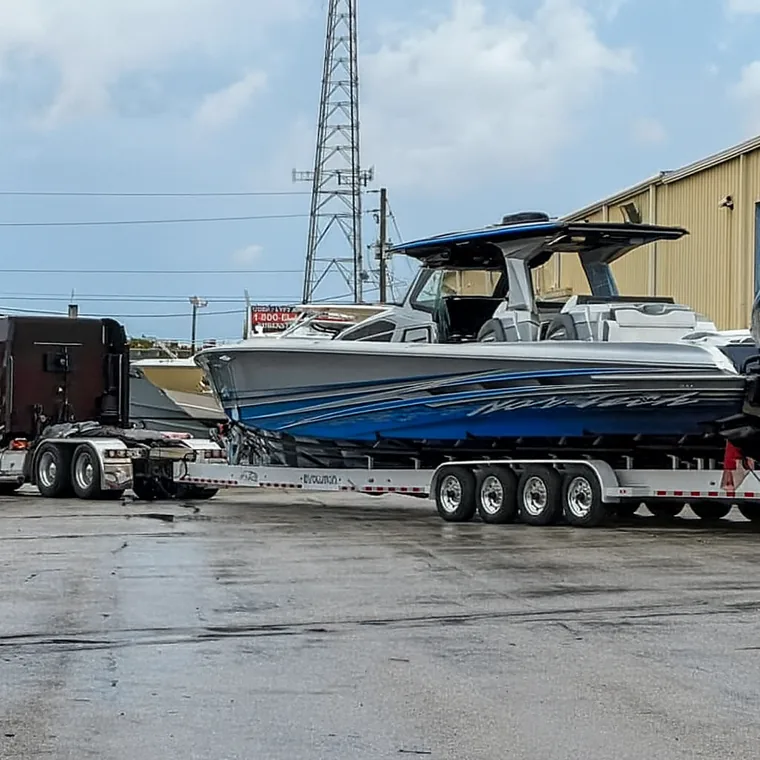
You call three numbers off a search page for boat transport. All three answer fast, all three sound confident, and all three want a deposit. Two of them will never put a hand on your boat.
That is not a scandal and it is not a scam. The transport industry is split into carriers and brokers, both licensed by the federal government, both doing legal work. The problem is that the websites do not make the difference obvious, and most owners find out which one they hired on the morning of pickup.
This post is how to find out first. It covers what the two words actually mean, how to look up any transport company yourself on a free government site, what a load board is and why it decides who shows up, and when hiring a broker is a perfectly sensible choice. Some of it is an argument for us. Most of it is just information you should have before you hand anyone a deposit.
Every licensing claim a transport company makes about itself is public, free, and checkable in about five minutes. Almost nobody checks. The section below shows you exactly where to click.
Two very different companies answer that phone
A motor carrier owns trucks, holds federal authority to haul freight for hire, employs or is the driver, and carries insurance on the equipment. When you hire a carrier, the company you spoke to is the company that arrives. If something goes wrong, the party responsible is the party you have a contract with.
A freight broker arranges transportation. It holds a different kind of federal authority, it does not own trucks, and it does not haul anything. It takes your job, posts it where carriers can see it, and pays a carrier less than you paid it. The difference is the brokerage fee. That is the entire business model, and it is a legitimate one that moves an enormous share of freight in this country every day.
The honest framing is not that brokers are crooks. It is that a broker is a middleman whose incentives point somewhere slightly different from yours. You want your specific boat handled well by someone competent. The broker wants the job covered by whoever will take it at a workable margin. Most of the time those two things line up. On a job with a deadline, an unusual size, or a boat worth more than the truck carrying it, they can come apart.
Read the language on the site. Phrases like “our network of vetted carriers”, “we have drivers in your area” and “nationwide fleet coverage” are broker phrasings. A carrier talks about its truck, its trailer and its driver, because it owns them and there are a countable number of them.
USDOT numbers, MC numbers, and what authority means
Three terms come up constantly and get used loosely, so here they are in plain English.
A USDOT number is a unique identifier the Federal Motor Carrier Safety Administration issues to a company that operates commercial vehicles or otherwise falls under its rules. Think of it as the company’s file number. It never changes and everything the agency knows about that company hangs off it. Ours is USDOT 2817526.
Operating authority, usually shown as an MC number, is permission to move freight for hire across state lines. It comes in types, and the type matters more than the number. Authority to haul property as a carrier is one thing. Authority to broker freight is a separate registration with separate requirements. A company can hold one, the other, or both. Ours is MC-939339, carrier authority.
Insurance on file means the company’s insurer has filed proof of coverage with the federal government, and that filing is public. This is the part people misread most often, and there is more on it below, because insurance on file and your boat is covered for what it is worth are not the same statement.
How to check any transport company in five minutes
This is the useful part of this article, and it works on us as well as on everyone else. Do it before you send a deposit to anybody.
- Go to safer.fmcsa.dot.gov. That is the federal Safety and Fitness Electronic Records system. It is free and it does not ask you to register.
- Choose Company Snapshot.
- Search by USDOT number if the company published one, which a legitimate operator will have done in its footer or on its about page. Otherwise search by company name. Name searches return near matches, so confirm the city and state before you trust the record.
- Read the record. The fields that matter are listed below.
Entity Type. The snapshot states plainly whether the record is a CARRIER, a BROKER, or both. This single line answers the question in the title of this post.
Operating Status. You want ACTIVE. If it reads OUT OF SERVICE, or the authority is listed as inactive or revoked, stop there and call someone else. Nothing else on the page matters if this line is wrong.
Power Units and Drivers. Power units means trucks. This is the tell. A carrier has power units and drivers listed, because it owns equipment and somebody drives it. A broker record typically shows zero power units and zero drivers, which is not a red flag in itself. It is simply what a broker is. It becomes a problem only when the company let you believe otherwise.
Operation Classification and Cargo Carried. These tell you what kind of work the company is registered to do. A record built around general freight and nothing resembling your job is worth a question.
Crashes. The snapshot reports crashes recorded in the last twenty four months. Ours shows zero over that window, and we have been hauling since 2015.
Run our number while you are there. USDOT 2817526. The record shows one power unit and one driver, because that is the honest reality of this operation. One truck, one owner driving it. That is the reason we can tell you who is showing up, and also the reason we sometimes have to tell you the week is full. Both of those come from the same line on the same public page.
For insurance, the companion system is the FMCSA Licensing & Insurance site, reachable from the same snapshot page. It shows which filings are active. Carriers file liability coverage. Brokers file a surety bond or trust fund instead, which exists to protect carriers from being stiffed on payment, not to protect your boat. Either way, the federal filing tells you a policy exists. It does not tell you the cargo limit or whether a boat like yours is inside it. Ask for a certificate of insurance sent directly by the agent, and check that the cargo figure is a number you can live with. Any real operator will send it without hesitating.
What a load board is, and what happens after you pay a deposit
A load board is a private online marketplace. Brokers post jobs, carriers with active authority shop for them, and money changes hands in the middle. It is ordinary infrastructure and it is how most freight in America finds a truck.
Here is the sequence when you book through a broker. You pay a deposit. Your job is posted to the board with the pickup, the delivery, the dates and the dimensions, along with the amount the broker is willing to pay. Carriers browsing the board decide whether that number is worth their week. One of them accepts. That carrier is the company that arrives at your dock, and it is the first time anyone has any idea who that will be.
The carrier who takes it might be excellent. Owner operators who do good work are all over those boards, including us on the occasions the lane and the calendar fit. The point is that the selection happened after you paid, based on a number, and you were not part of it.
This also explains a thing that confuses people. If your job sits on the board and nobody accepts it, nothing happens. No truck is assigned. The dates slide. The broker is not being lazy, it is that the posted amount is not attracting a carrier, and the usual fix is to raise it, which brings us to pricing.
Why the cheapest quote is often the least reliable one
A carrier quoting your job is quoting its own week. It knows the miles, the fuel, the permits if the boat is wide, and what else is on the calendar. It either does the job for that number or it does not.
A broker quoting your job is predicting what some unnamed carrier will later accept, then adding margin. That prediction can be wrong, and the incentive when quoting is not accuracy. It is winning the deposit. Once the deposit is in, the job can be posted and repriced, and the awkward conversation happens later.
That is the mechanism behind bait and switch pricing. The pattern looks like this, and it is consistent enough to be a checklist.
- A quote conspicuously below everything else you were told, from a company that asked you fewer questions than the others.
- A deposit requested before any carrier is named or any pickup date is confirmed.
- Terms that let the company revise the price after booking. Read that clause. It is usually there in writing.
- The date quietly moving, then a call explaining that the price has to go up to get a truck on it.
- Reluctance to put the total, the cargo coverage and the cancellation terms in one email.
The fair version of this. Plenty of brokers quote honestly and cover the load at the number they gave you. But a low quote from a company that will not name a carrier is a bid to win your deposit, not a price to do the work. Treat those as two different things and most of the confusion in this industry disappears.
Check us before you call us
Run USDOT 2817526 through the FMCSA snapshot first. One truck, one driver, no crashes on the record. Then send the two ends of the trip and the beam.
Ask who is driving, and listen to how they answer
This is the fastest single question there is. Ask any transport company: who is the driver, and what company do they work for?
If you are talking to a carrier, the answer is immediate and specific, because there is a person and a truck attached to your job. If you are talking to a broker, the honest answer is that they cannot tell you yet, because the carrier has not accepted the load. Both answers are truthful. They just describe completely different arrangements.
The answer worth worrying about is the vague one. One of our drivers. We will assign it closer to the date. Our team handles that. A company that is a broker and says so is being straight with you. A company that is a broker and lets you assume it owns the truck has told you something about how the rest of the job will go.
It matters more than it sounds. The person who drives is the person who decides how your boat is blocked and strapped, how it is padded where the straps cross, which route clears the height on the trailer, and how carefully it comes off at the other end. On boat transport in particular, most of what determines whether the boat arrives in the condition it left is decided by one set of hands.
When a broker is genuinely the right call
Anyone telling you to never use a broker is selling something. There are jobs where a brokerage is the sensible option and probably the cheaper one.
A broker is usually fine when:
- The lane is long and common. Coast to coast on interstates is exactly what load boards are built to fill.
- Your dates are flexible. A window of a week or two absorbs the time it takes a load to get covered.
- The item is standard sized and replaceable. A daily driver sedan on an open trailer is a commodity move.
- You genuinely do not care who arrives, as long as it arrives.
- Nobody has to be met, coordinated with, or persuaded to release the boat at either end.
A broker is genuinely risky when:
- The boat is high value, custom, or hard to replace. The carrier’s cargo limit, not the broker’s bond, is what stands behind it, and you will not know that number until after the load is covered.
- There is a hard deadline. An event, a closing date, a buyer flying in, a slip reservation. A load that has not been accepted has no truck, and no amount of follow up changes that.
- The load is oversize. Wide beam work means permits from every state on the route, and sometimes escorts and daylight only travel. That takes planning by the person actually driving it, not a posting.
- Pickup is complicated. Marina lifts, yard releases, gated storage, a seller who has to be there. Every handoff added to a chain of unknown parties is a place for it to break.
- You are moving something you will move again. Repeat work with someone who already knows the boat is worth more than a slightly better number once.
Our own view, for whatever it is worth from an obviously interested party: use a broker for the commodity move and a carrier for the one you would be upset about. The same logic applies to auto transport, where a classic or a collector car sits in a very different category from a lease return.
What to ask before you book anything
Print this, or just keep it open while you make calls. None of these questions are rude and every one of them is answerable in a sentence.
- Are you a carrier or a broker? If the answer is both, ask which authority they will be using for your job specifically.
- What is your USDOT number? Then check it yourself while you are still on the phone.
- Who is the driver and what company do they work for?
- What is your cargo insurance limit, and will you email me the certificate? The certificate, not a screenshot of a policy number.
- Is the price you just gave me final, and is that in writing?
- What happens if the date moves, and what is your cancellation policy?
- Have you hauled a boat this size before, and what did you do about beam and height?
- Can you give me the number of a customer you moved something similar for?
Ask us the same list. Xclusive Transport Services is a licensed motor carrier out of Eldon, Missouri. USDOT 2817526, MC-939339, hauling since 2015, no crashes on the record in the last twenty four months, A plus with the BBB. One truck, one driver, and the owner is the driver. That means your boat is handled by the person who quoted it, and it also means the calendar is finite and we will tell you when it is full rather than sell you a date we cannot hold.
If you want the detail on how the company is put together, it is on the about page. If you are moving something on or off the water near home, see Lake of the Ozarks boat transport. And if you would rather just talk it through, send the two ends of the trip and we will tell you plainly whether it is a job for us or one you should give to somebody else.