
Buying a Boat Out of State: How to Get It Home
The right boat is almost never on your lake. Here is the order to do things in, what to check before money moves, and the measurements a carrier actually needs from you.
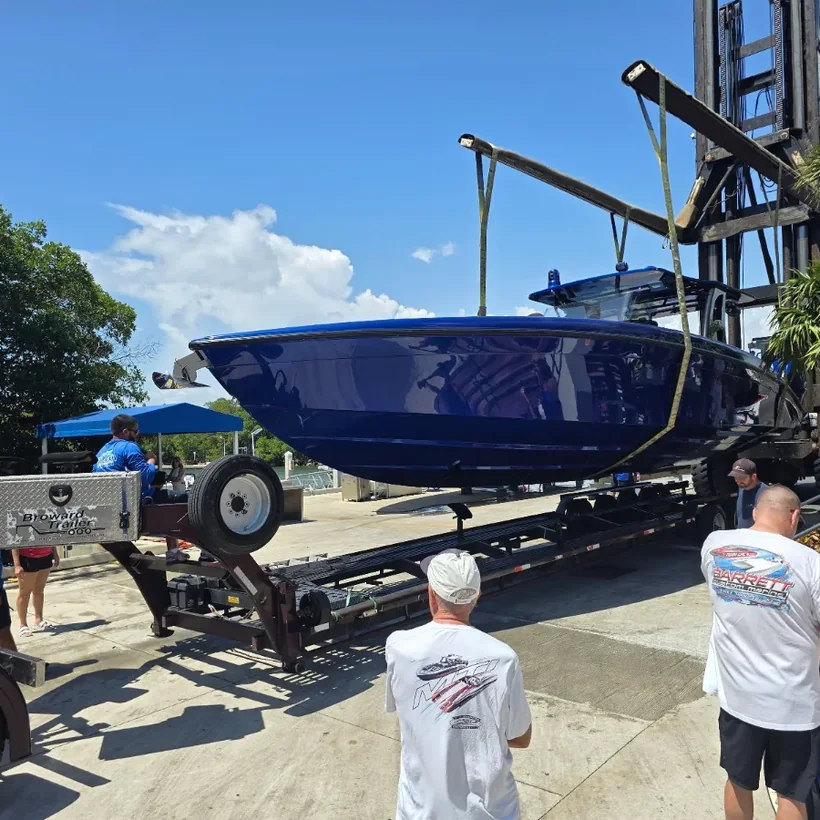
The boat you actually want is rarely sitting on your lake. It is on a trailer in Michigan, or in a broker’s yard in Florida, or under a cover behind a house in Texas belonging to somebody whose kids grew up and stopped going out on weekends. Widen the search past a day’s drive and the market gets dramatically better.
The part that stops people is not the buying. It is the six hundred miles between the boat and the driveway, and the uncomfortable feeling of sending money to a stranger for something you have never stood next to.
That is a solvable problem, and it is solved by doing things in the right order. What follows is that order, written by the people who show up at the end of it. We haul boats bought out of state most months of the year, and the deals that go badly almost always went wrong two steps before the truck was ever called.
The single most common mistake: booking transport before the title is confirmed clear. Line up a carrier early, but do not commit to a pickup date until you know the seller can legally hand you the boat.
Do these things in this order
Almost every horror story in out of state boat buying comes from doing step four before step two. The sequence below is not complicated, it is just unglamorous, and skipping ahead is what costs people money.
- Agree a price subject to inspection, in writing, even if the writing is a text message.
- Run the hull identification number and check for liens before anything else happens.
- Get eyes on the boat. Yours, a surveyor’s, or somebody local you trust.
- Confirm the seller physically holds a clean title in their own name.
- Measure the boat properly and get a transport quote against real numbers.
- Pay, take possession on paper, and only then put a truck on a date.
Steps two and four are the ones people skip because they feel like formalities. They are not. A boat with a lien on it is collateral for somebody else’s loan, and paying the seller does not make that go away.
Inspection when you cannot be there yourself
Photographs are marketing. Every listing photo was taken in good light from the angle that flatters the boat most, and none of them show the transom, the stringers, or the smell inside a closed cabin.
For anything with real money in it, hire a marine surveyor near the boat. An accredited surveyor works for you, not the seller, and a survey report tells you about moisture in the hull, soft spots in the deck, corrosion, and the honest state of the engine hours. On an older fiberglass hull that report is the difference between a good buy and a project you did not agree to.
If the boat is not worth a full survey, you still want a human being standing next to it. Options that work: a local mechanic paid for an hour, a friend of a friend on that lake, or a video walkaround where you direct the camera live rather than accepting a clip the seller filmed alone. Ask for the bilge, the transom, under the engine cover, the trailer frame, and the tires with the date codes visible.
A sea trial is worth the trip if you can get one. An engine that starts in a driveway and an engine that holds temperature under load for twenty minutes are different engines. If the boat is winterized or the lake is frozen, price the deal as if the engine is unknown, because it is.
Title, liens and the HIN check
Boats are titled differently from state to state, and that inconsistency is where trouble hides. Some states title the hull, some only register it, and some title the trailer separately from the boat. You need to know which situation you are buying into before you send money.
The hull identification number is a twelve character code, usually on the starboard side of the transom near the top. Get a clear photograph of the actual stamped number and compare it character by character against the title and the listing. A mismatch is not a typo to be shrugged off.
Check for liens through the titling agency in the state where the boat is currently titled, and ask the seller directly whether there is a loan against it. If there is, that is normal and it is handled by paying the lender directly rather than paying the seller and trusting them to settle up. Get the payoff letter.
Confirm the name on the title matches the person selling it. A boat titled to a spouse, a parent, an estate, or a dissolved LLC needs extra paperwork before it can transfer, and finding that out on pickup day means the truck is standing there while somebody looks for a death certificate.
Ask your own state what it will want. Bill of sale, signed title, sometimes a notarized signature, and sales tax paid where you register rather than where you bought. Every state is different. A ten minute phone call to your own DMV or department of revenue before you buy prevents a genuinely miserable afternoon later.
The numbers a carrier actually needs
This is where we can be most useful, because sellers guess and listings round. A quote built on the wrong beam is not a quote.
- Beam, meaning maximum width. Measure the widest point of the hull, including rub rails and any flare. This is the number that decides whether the load needs oversize permits, and it is the one most often reported wrong.
- Overall length. Not the model number. A boat sold as a twenty four footer is frequently longer than twenty four feet once the swim platform and the bow pulpit are counted.
- Height on the trailer, measured from the ground. Stand on level ground and measure to the highest fixed point. Then tell us separately what can come off: radar arch, tower, bimini, antennas, outriggers. Height is what decides the route.
- Weight, dry plus whatever is in it. Gear, batteries, a full fuel tank, water in the bilge. It adds up faster than people expect.
- Trailer or no trailer, and if there is one, whether the tires, bearings and lights are actually road worthy.
Send photos with the numbers. A shot from directly behind, one from the side, and one of the trailer coupling tells us more in three seconds than a paragraph does. If something does not fit our lowboy, we would much rather know that while you are still negotiating than on the morning we arrive.
Anything over about eight and a half feet of beam is oversize, which means permits from every state the load crosses and sometimes daylight only travel. That is routine work and it is planned in advance, but it needs real numbers to plan against. Our boat transport page covers what fits, and pontoons have their own set of complications on the pontoon and tritoon page.
Arranging pickup when you are not the one standing there
In most out of state purchases the buyer never meets the truck. Somebody else releases the boat: the seller, a marina, a broker, a storage yard, a neighbor with a gate code. Every one of those handoffs is a place where a day gets lost.
What makes it go smoothly is embarrassingly basic. Give the carrier a name and a working cell number for whoever will be physically present. Confirm that person knows the date and has authority to release the boat. If it is a marina or a storage facility, find out their hours, whether they need a release form from the seller on file, and whether a lift or a forklift is involved and who is paying for it.
Access matters as much as it does with a car. A lowboy with a boat on it is long and heavy and does not reverse out of a gravel drive that ends in a turning circle sized for a pickup. Ask what the approach looks like. If it is tight, we will find a nearby lot with room to load, which costs nothing when it is planned and costs a day when it is discovered.
One more: if the boat has been sitting, the trailer tires are probably older than they look and the bearings may not have been greased since the last administration. Tell us and we will plan for it rather than find out at highway speed.
Found the boat? Send us the numbers.
Beam, length, height on the trailer, and where it is sitting. We will tell you what the haul home looks like and whether it needs oversize permits, before you finish negotiating.
Paying safely across state lines
You are sending a significant sum to somebody you have never met, for an object you have possibly never touched. Slow down at exactly this point.
- Never wire a deposit before the title has been verified. A wire is gone the moment it lands. This is the single most common way people get hurt.
- Use escrow on higher value boats. A marine escrow service or a title company holds the money until the paperwork clears. It costs a small percentage and it removes the entire category of risk.
- If there is a lien, pay the lender directly for the payoff amount and the seller for the balance. Get the lien release in writing before the boat moves.
- Get a signed bill of sale with the HIN, the date, the price, both names and addresses, and the words as is if that is the deal. Your state will want it and so will you if anything is disputed.
- Insure it from the moment you own it, not from the moment it arrives. The boat becomes yours at the handoff, and a carrier’s cargo coverage is the carrier’s coverage, not a replacement for a policy in your name.
On our side, the transport is a separate transaction from the purchase and it should stay that way. We are not an escrow service and we do not hold money for sellers. Anybody in transport who offers to sit in the middle of your purchase is doing something outside their business.
Carrier or broker, and why it matters more here
On an out of state purchase the transport company is your representative at a place you cannot be. That raises the stakes on who it actually is.
Most companies that come back in a search are brokers. A broker posts your load to a national board and whichever carrier accepts it is the one who arrives at your seller’s driveway, meets your seller, and handles your boat. That selection happens after you pay, and you are not part of it. It is legal and it is often fine. It is a bad fit when there is a seller to coordinate with, a marina with hours, a lift to schedule, and an oversize load that needs permits pulled by whoever is driving.
We are a licensed motor carrier. USDOT 2817526, MC-939339, based in Eldon, Missouri, hauling since 2015, no crashes on the federal record in the last twenty four months, A plus with the BBB. One truck, one driver, and the owner drives it. The person who quotes your haul is the person who talks to your seller and straps your boat down. You can verify all of that yourself on the FMCSA site, and the carrier versus broker post walks you through exactly where to click.
The tradeoff is honest: one truck means a finite calendar. If the week you need is full we will tell you it is full rather than take a deposit and figure it out later.
What to do the day it lands
Be there if you possibly can, and if you cannot, send somebody who will actually look rather than wave the truck in.
Walk the boat with the driver before anything is unstrapped. Compare it against the photos taken at pickup, which we take as a matter of course. Look at the hull sides where the straps crossed, the transom, the prop, the rub rail, and the trailer frame. Note anything you see on the condition report while the driver is standing there. That is the entire purpose of the document and it protects both of us.
Then, before you launch: pull the drain plug situation straight in your head, grease the trailer bearings if the boat came a long way on old ones, check the battery, and put fresh fuel in it rather than trusting whatever has been sitting in the tank since the seller stopped using it. Register and title it in your state promptly, because most states have a window and the fine for missing it is pure waste.
If the boat is landing anywhere near us, that first launch is usually at the lake. Our Lake of the Ozarks boat transport page covers ramp, marina and private lift deliveries, and Missouri auto and boat transport covers the rest of the state.