
How to Prep Your Boat for Transport
Everything that should come off, drain out, or get tied down before the truck arrives, plus the measurements to have ready and the photos worth taking.
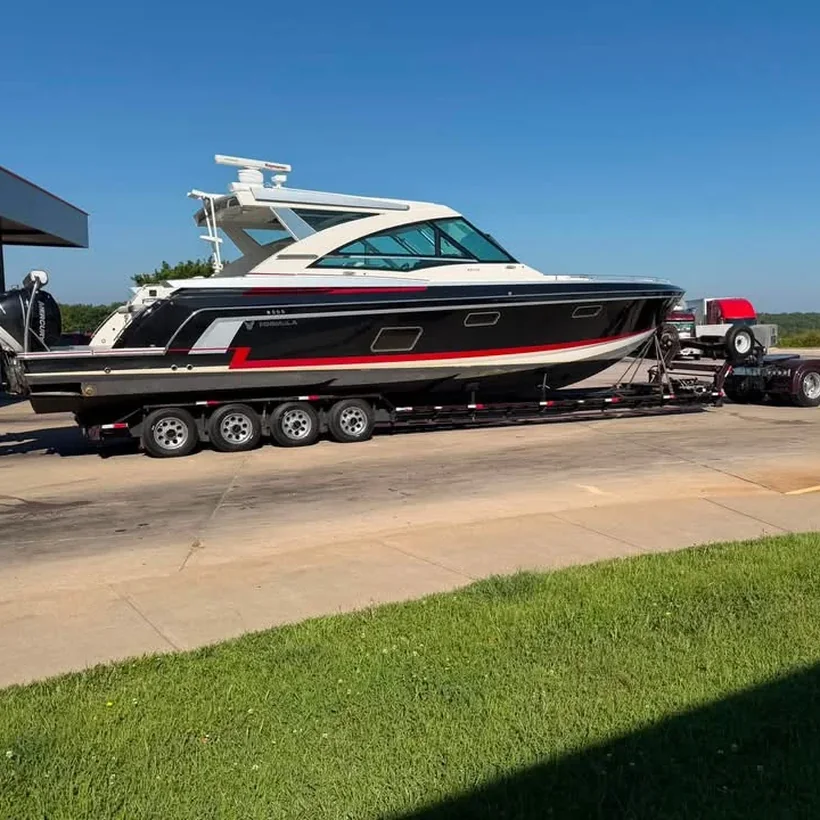
Most of what goes wrong on a boat haul is decided before the truck ever shows up. Not by anything dramatic, just by a canvas nobody took down, a hatch that was not latched, or a trailer tire that was old two seasons ago.
None of the prep below is hard and almost all of it is free. It takes an afternoon at most, and it is the difference between a boring haul and a phone call you did not want.
Work through it in order. The measurement section at the end is the one to do first if you have not booked yet, because those numbers are what a real quote is built on.
Do the measurements before you call anybody. Beam at the widest point, length overall, height from the ground with the boat on its trailer, and rough weight. Everything else on this list can wait until the week of.
Everything that should come off the boat
Wind at highway speed is not the same as wind at the dock. Anything that can catch air, work loose, or vibrate free over several hundred miles will try to.
- All canvas. Bimini, camper enclosure, mooring cover, snap on covers. Canvas that survives a season on the water can be destroyed in one trip, and a cover that lets go at speed becomes a hazard to whoever is behind the truck.
- Antennas, outriggers and flag poles. Anything that unscrews should come off. If it folds, fold it and secure it.
- Electronics that lift out. Chartplotters, fishfinders, VHF handhelds and anything in a bracket. Take them home rather than leave them in the cabin.
- Loose gear. Life jackets, cushions, fenders, lines, coolers, rods, anchors, tools, tackle. Either take it off the boat or stow it below in a locker that latches.
- Drain plugs, out and stored somewhere you will remember. Tape them to the helm if you are the sort to lose them.
- Anything of value. Cargo insurance covers the vessel, not the contents. The rule is simple: if losing it would ruin your week, it does not ride on the truck.
Shrink wrap is not a substitute for removing things. It protects the finish and keeps weather out. It does not hold down a bimini frame or stop an antenna vibrating loose underneath it.
Water, fuel and everything that sloshes
Water weighs a great deal and it moves while the truck moves, which is worse than the weight alone.
Pull the drain plug and let the bilge empty completely. Drain the fresh water tank and the water heater. Empty the holding tank properly at a pump out, both because of the weight and because nobody wants the alternative on a warm day. Run the head dry.
Fuel is a judgment call. Less fuel means less weight, which matters on a permitted load with axle limits. But a nearly empty tank on a boat that is then going to sit invites condensation. A quarter tank is a reasonable middle for a boat that will be used soon after arrival. If the boat is going into long storage at the far end, fill it most of the way and add stabilizer instead.
In freezing weather, winterize before the haul rather than after. A boat that leaves Missouri in November and arrives somewhere warm has still spent two nights outside on the way.
Latches, hatches and everything that swings
Go around the boat and close, latch and lock everything. Cabin doors, engine hatches, deck plates, anchor locker, glove boxes, windows and ports. A hatch that flaps for six hundred miles will wear its hinges out or take itself off.
Cleat off or remove all lines so nothing can trail. Secure the anchor properly rather than leaving it resting in the roller. Lock the outboard in the down position if that is how it travels, or support it with a transom saver, which takes the load off the transom and the trim rams. For an inboard or a stern drive, trim the drive fully down unless clearance says otherwise, and check with the hauler if you are unsure which way your setup should travel.
Disconnect the batteries, or at least turn the master switch off. It stops anything drawing down over a multi day trip and it stops a bilge pump cycling against a plug you already pulled.
The part that strands loads
When a boat haul goes wrong on the road, the trailer is usually why. Boats sit, and trailers sit under them, and rubber and grease do not care that the boat looks fine.
- Tires. Check the pressure cold and check the date code stamped on the sidewall. A tire more than about six years old should be replaced regardless of how much tread is left. Look for sidewall cracking, which is the real tell.
- The spare. Have one, and make sure it holds air and that the tools to change it are actually with the trailer.
- Bearings. Repack them if it has been a while, and check the hubs are not running hot after a short tow. Bearing failure is the single most common way a trailer ends a trip early.
- Lights and wiring. Test brake lights, turn signals and markers. Replace corroded connectors rather than wiggling them until they work.
- Coupler, safety chains and jack. Everything moves freely and is not seized or bent.
- Winch strap and bow stop. The strap should be in good condition and the boat should be snug against the stop, plus a separate safety chain at the bow.
- Straps at the stern. The boat should be secured to the trailer independently of the winch.
Ready to book, or still measuring?
Send beam, length, height on the trailer and both ends of the trip. We will tell you what the haul looks like and what needs to come off before we arrive.
The twenty minutes that settle any argument
Do this in daylight, the day before pickup, with the boat clean enough that the photos show the surface rather than the dirt.
Take all four sides, the bow, the stern, the transom, the hull below the rub rail on both sides, the deck, the helm, the prop and lower unit, and the trailer including the tires. Get close on anything already damaged, because the point is as much to document existing scratches as to catch new ones. Make sure the timestamps are on and keep the originals rather than compressed copies sent through a messaging app.
We photograph the boat at pickup as well, and the condition report gets signed at both ends. Two sets of photos and a signed document mean there is never a conversation about whether a chip was there before, which protects you and protects us equally.
The numbers to have ready before you call
These four numbers are what a quote is actually built on, and getting them right is the single most useful thing you can do.
- Beam. The widest point of the hull including rub rails and any flare. Not the brochure number. This decides whether the load is oversize.
- Length overall. Bow pulpit to the back of the swim platform, not the model name.
- Height. From the ground to the highest fixed point with the boat on its trailer, on level ground. Then list separately what can come off: arch, tower, antennas, outriggers.
- Weight. Boat plus trailer plus whatever is still aboard. Honest, not dry weight.
Send photos with the numbers. One from directly behind, one from the side, and one of the trailer coupling tells us more than a paragraph does. If something will not work on our lowboy, or the beam pushes it into permit territory, we would much rather tell you now than on pickup day. The cost breakdown explains what each of these numbers does to the price.
What should happen when the truck arrives
Someone should be there, or someone you have named should be there. Have the keys, the paperwork, and any gate codes or facility contacts ready.
Walk the boat with the driver before anything is loaded. Point out anything already damaged and anything unusual about how the boat should be handled. Get the condition report signed. Confirm the delivery contact and the phone number for the far end, and confirm the address is somewhere a truck can actually get to, because a lowboy with a boat on it does not reverse out of a tight gravel drive.
Then let the driver work. Blocking, strapping and padding where the straps cross is the part that decides whether the boat arrives in the condition it left, and it is the part worth not rushing.