
How Much Does It Cost to Ship a Car?
Every guide to car shipping cost leads with a number. This one does not, because the number on a calculator is not a quote and the companies publishing those numbers know it.
How much does it cost to ship a car is the most searched question in this industry and the worst answered. Search it and you get pages of ranges, per-mile averages and calculators that spit out a figure in four seconds. Almost all of that is lead capture wearing a helpful face.
There are no numbers on this page. No range, no per-mile figure, no average. That is deliberate. Any price written on a web page before anyone knows your two addresses, your vehicle, your dates and what else is moving that week is a guess, and the guess is usually shaped to be low enough to make you submit the form.
What follows is every real factor that moves the price, why it moves it, and how to read the quotes you get back so the cheap one does not turn into the expensive one after your car is already promised to somebody.
Everything below is something we would ask you about before quoting. If a company hands you a price without asking most of it, that price is not a price yet.
Why this page has no numbers on it
Shipping a car is not a product with a shelf price. It is a seat on a truck that is already going somewhere, and the cost of that seat depends on what else is on the deck, where the truck is coming from, and whether it has anything to carry on the way back.
The same car, on the same route, in the same month, can price differently two weeks apart. Nothing dishonest happened. The truck simply had a different load around it. That is normal for freight and it is the reason a fixed published rate for auto transport does not exist anywhere that is telling you the truth.
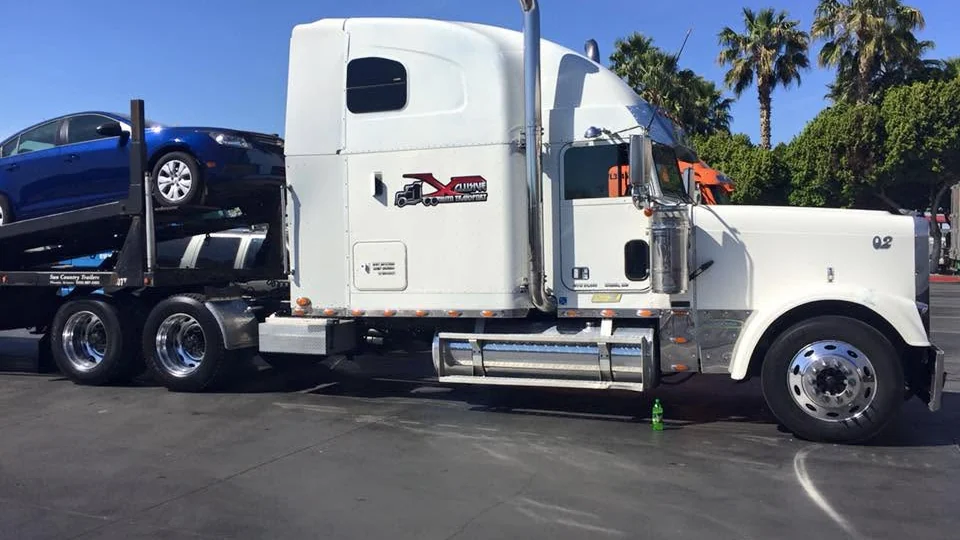
It is worth saying what we are. Xclusive Transport Services is a licensed motor carrier, USDOT 2817526 and MC-939339, hauling since 2015 with no crashes in the last twenty four months and an A plus rating with the BBB. One truck, one driver, an open car hauler for vehicles and a lowboy for boat transport. When we quote a run we are quoting our own calendar, which is the only reason we can quote it at all.
What a car shipping calculator is actually doing
Type two zip codes into a car shipping calculator and something happens instantly. That speed should tell you what it is. Nothing was checked. No truck was consulted. Nobody looked at a calendar.
Under the hood, most of them take the driving distance between two zip codes, multiply it by an internal per-mile figure pulled from historical load board data, and nudge the result for vehicle type. That is it. The output is a statistical average of what other people paid on roughly similar lanes at some point in the past. It is not an offer, and the fine print will usually say so in smaller type than the number itself.
A calculator does not know four things that decide your price. Whether a truck is actually running your lane in your window, what else is on that truck, whether the return leg has freight, and whether either end of your trip is somewhere a car hauler can physically get to.
Use a calculator the way you would use a weather average for a wedding date. It tells you the shape of the thing. It does not tell you what will happen on your day.
The low quote that gets raised later
Most companies that come back when you search for car shipping are brokers, not carriers. A broker owns no trucks. They take your booking, then post your car to a national load board at a price and wait for a carrier to accept it.
Follow that through and the incentive becomes obvious. The broker who quotes lowest wins your booking. The carrier who accepts the load decides whether the job is worth taking. When the posted price is too low for anyone to accept, your car sits, and eventually you get the call: the market moved, we need more to get it covered. Most people pay it, because by then they have a date to hit.
That is not always a scam. Plenty of brokers are straight, and a good one quotes realistically instead of quoting to win. But the structure means the lowest number in your inbox is very often the one most likely to change, and it is why a quote from a broker and a quote from a carrier are not the same kind of object even when the figures look comparable.
When we quote, the person quoting is the person driving. There is nobody to hand the load to and no board to post it on. If the week is full, the answer is no rather than a lower number now and a phone call later. More on how the company is set up is on the about page.
Distance matters, the route matters more
Mileage is the obvious input and the least interesting one. Two runs of identical length can price very differently depending on where the miles are.
- Corridor versus off corridor. A pickup near a major interstate is easy to fold into a route. A pickup two hours off it costs the truck half a day and burns fuel carrying nothing.
- What happens after. A run that ends somewhere with freight heading back prices better than a run that ends where the truck has to drive home empty. Empty miles are the single most expensive thing in trucking and somebody always pays for them.
- Population at both ends. Dense metros generate constant vehicle movement. Rural ends do not, which is why a car going to a small town can cost more than one going twice as far to a city.
- Terrain and season on the route itself. Mountain passes, winter corridors and construction detours all add hours that have to be paid for.
Then there is access, which people almost never think about until pickup day. A car hauler is long, tall and heavy. It does not fit down a narrow residential street, under low branches, into a tight cul de sac, or through most gated communities and apartment complexes. When the truck cannot reach the address, the answer is a nearby lot with room to load, which is routine and costs nothing extra if it is planned instead of discovered.
Tell whoever is quoting you what the street is like at both ends. It is a thirty second conversation that prevents the most common day-of problem in this business. Runs inside the state are the easy case, and Missouri auto and boat transport is where most of our short-notice work comes from.
Size, weight and whether it rolls
Your car is buying space and payload on a trailer with a hard limit on both. That is the whole logic of vehicle pricing, and it explains everything that looks arbitrary from outside.
- Length and height. A crew cab dually eats the space of a sedan and then some. Height matters on the upper deck, where clearance is finite.
- Weight. The trailer has a legal payload. Heavy vehicles limit what else can ride, so they carry more of the load cost.
- Modifications. Lift kits, oversized tires, roof racks, ladder racks and roof tents all change the numbers. Measure with them on, because that is how the car arrives.
- Ground clearance. Lowered cars need extra ramps and a slower, flatter load. It is doable and it takes time.
Non-running is a real category, not a detail. A vehicle that does not start still needs to roll, steer and brake to be winched on safely. If any one of those three is gone, it needs different equipment and sometimes a different truck. Say so up front. A driver who arrives expecting a runner and finds a project car has a problem that cannot be solved in the street.
Nobody is annoyed by an honest description. What causes trouble is a car listed as running because it ran last spring.
Want a number that is actually yours?
Send both zip codes, the year make and model, whether it runs, and the window you are working with. We price the real run, and we say no when the calendar is full.
Open transport, and why we do not offer enclosed
We run an open car hauler. We do not offer enclosed transport, and we will tell you that in the first minute rather than the last.
Open is how the overwhelming majority of vehicles in this country move, including every new car that reaches a dealership. The car is exposed to weather and road grime for the length of the trip, the same conditions it would face being driven the same distance. For daily drivers, family cars, trucks, relocations and most classics that already see road use, open is the correct choice and not a compromise.
Enclosed costs meaningfully more, and the reason is supply. There are far fewer enclosed trailers, they carry fewer cars per load, and the wait for one on a given lane is longer. That premium is real and sometimes it is worth paying: concours cars, anything genuinely irreplaceable, fresh paint, and vehicles so low that open loading is a fight.
If that is your car, we are not the right truck and we will say so. If it is not, open auto transport does the job and you keep the difference.
Season and flexibility move the price more than people expect
Auto transport has seasons, and they are directional. Understanding them is the closest thing to a lever you actually control.
In late autumn, an enormous volume of vehicles moves north to south as people leave winter behind. In spring the whole thing reverses. During those windows the busy direction gets tight and the empty direction gets cheap, because trucks still have to come back either way. If your move happens to run against the flow, you benefit. Snowbird vehicle transport is its own booking problem for exactly this reason, and the fix is booking well before the herd does.
Summer is the general relocation peak, driven by school calendars and closing dates. January and February bring weather that closes routes and turns a two day run into a four day one. Holidays compress everything into fewer working days.
Flexibility is the other half. A pickup window of several days lets a run be built around other freight. A single fixed date means the truck works around you instead, and that has a cost. If your date is immovable, say so early, because the earlier it is on the calendar the less it costs to protect.
How to compare quotes without getting fooled
Get three quotes. Then ignore the numbers for a minute and ask each company the same short list of questions. The answers sort the quotes faster than the prices do.
- Are you a carrier or a broker? Both can be fine. Only one of them is the truck. A straight answer here tells you a lot about the rest.
- What is your MC number? Every legitimate operator has one and will give it over the phone. You can look it up on the FMCSA site in a minute.
- Is this price guaranteed, or an estimate? Ask for it in writing. This one question separates real quotes from opening offers.
- What happens if no carrier accepts the load? A broker should be able to answer without hedging. If the answer involves revisiting the price, you have learned what the number really is.
- What is the deposit, and is it refundable? Know the terms before anything is charged.
- Can I see the certificate of insurance? It should arrive without friction.
- Who do I actually call while my car is moving? Find out whether that is the driver or a queue.
Treat the lowest quote as the least reliable one until proven otherwise. In a market where anybody can publish any number to win a booking, the outlier at the bottom is usually the one with the most room to move later.
Also read what a quote includes. Door to door or terminal. Insured for what value. Running or non-running assumed. Deposit and balance terms, and what form the balance is due in. Two quotes that look a certain distance apart can be identical once those are lined up, and occasionally the higher one is cheaper when everything is counted.
When you are ready for a number that belongs to your actual run rather than to an average, send us the details and we will price it or tell you straight that the week is full.